Approximately once a month, are some important threats that can compromise more than 1,300 millions of Android-equipped devices. Even though, as we have stated on other occasions, most of the attacks are stopped in time and not are of greater importance, there are others that get skip controls and somewhat more dangerous if we do not act quickly. And it is that, with the new security enhancements that incorporate, both manufacturers and developers of the interfaces in the new models also see a greater complexity of malicious elements that can infect our tablets and smartphones.
Previously, I have given you more information about new methods such as banking Trojans or Ransomware and that in some regions of Eastern Europe are still rather widely used by hackers to get, not only personal information of thousands of users, but also numbers of bank accounts and financial information that can be very harmful for them if used fraudulently. Here, we present the Scareware, an old enemy known from the makers of the Green robot software but it has gone unnoticed by most of the public and we also say to you how to prevent it so that, as is the case with most viruses and harmful objects, they are only in an anecdote.

What is it?
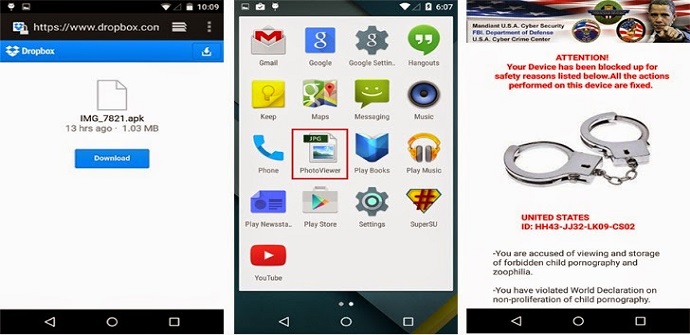
The Scareware collects items of Adware, which we have already spoken on other occasions, and at the same time, Trojans and virus most common in Android. Roughly works in the following way: we received an notice, which in most cases seems to come from trusted sources like Google, the designers of the antivirus that we have and, in some cases, the manufacturers themselves of our terminals. In these messages, will let us know that we have been attacked and that must click on an address added to be able to solve the problem. Add to this, certain “Symptoms” that can give us to understand that something is failing really like for example, turning the device off, they begin to vibrate or are blocked temporarily.
The psychological factor
If we have been victims of these objects, it should be clear from the first moment that, if we have not clicked on the link that accompanies the messages, we have not been infected and there is no virus on our device. The fact that the terminal stops responding, is linked to the Scareware composition that pretends to feel insecure and think that really, the devices have been attacked when it doesn’t.
Is it important?
The Scareware is something with what Android developers have years living together. However, not is of more importance to be viruses that, on the one hand, are simple to remove and secondly, it’s very simple elements full of failures that in the majority of cases, fail to take forceful action against our tablets and smartphones. In any case, there are some more elaborate that may be more credible to users containing information such as software version equipped with the device, the specific model and addresses false but which contain a visual appearance very similar to the trusted apps.
How to prevent it?
As with most viruses and malicious objects, preventing the Scareware is easy. Most importantly, is not never click the URL attached to the message when we receive it. Where we have agreed to the message, the malware has the ability to modify your browser and obtain data such as passwords or the most visited websites. If need be, we can delete it through the “settings” menu and then, by going to the applications menu, where you can select the browser and delete content as history. There are cases where we can be infected through applications. In these situations, the best will be erase data stored on them and uninstall them. On the other hand, the recipe to prevent it returns to it always: good antivirus, using only tools from leading developers and ignore all those messages that offer Premium content or non-existent prizes.

As you have seen, the Green robot platform, it is still the target chosen by the hackers to carry out their attacks. However, elements such as the Scareware does not have greater importance and do not require advanced knowledge or complex tasks to eradicate them. After learning more about this element which is returning to pick up and climbing posts among the methods most used to attack devices, do you think that it is a real threat that may cause more damage if not stopped in time, or however, believe that it is one of the two million vulnerabilities detected in Android that is of greater importance? You have available more information as for example, a list of actions that we should not do in this operating system to avoid being infected so you can learn more about the threats to which we expose ourselves to use our tablets and smartphones.
The article How can affect your Android the Scareware? It was published in TabletZona.